Which websites does Google AI Mode cite most often?
Summarize with ChatGPTClaudePerplexity
TL;DR
- Google, Reddit, and YouTube repeatedly appear among the most prominent Google AI Mode sources, but Ahrefs and Surfer produce different leaders because their panels and denominators differ.[15][1]
- Google-hosted destinations need separate classification because published studies include SERPs, Business Profiles, support pages, and other Google properties—not only independent websites.[9][6]
- AI Mode’s overlap with classic organic results ranges from 12% strict URL overlap in Moz to approximately 35% URL overlap in Semrush, reflecting different methods rather than one settled statistic.[15]
- Published link counts are not interchangeable: SE Ranking reported 12.6 URLs per response, while Semrush reported seven unique sidebar domains and Moz found 91% of answers cited at least 10 sources.[6][14]
- To audit your domain, preserve the prompt, date, surface, visible citation, destination type, citation position, and explicit denominator instead of relying on an undated visibility score.[25]
Evidence first: which websites does Google AI Mode cite most often?
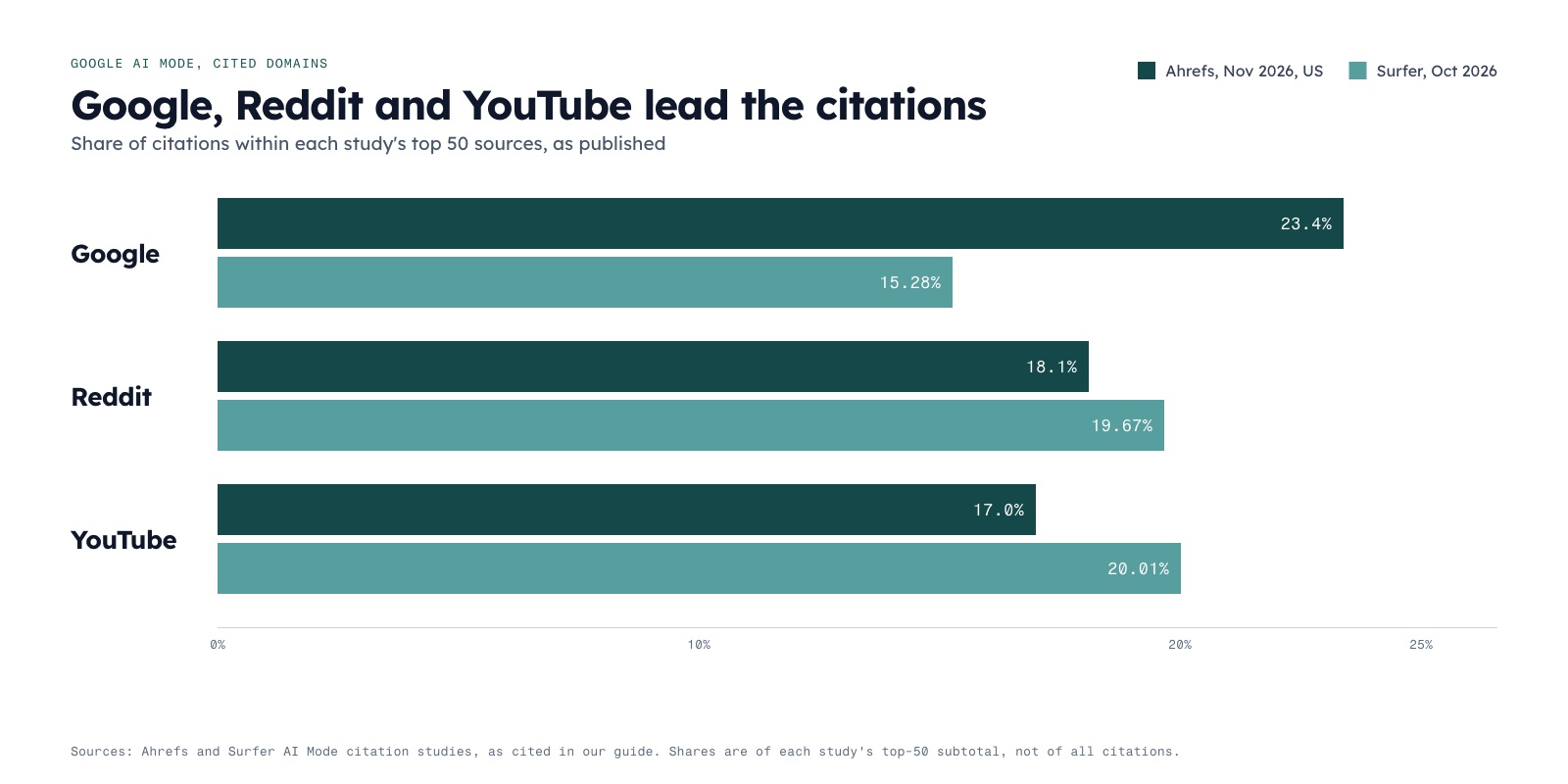
Google AI Mode does not have one permanent “most-cited websites” list. Recent studies produce different leaders because they use different prompts, dates, populations, and counting rules: Ahrefs ranks Google, Reddit, and YouTube first in its November 2026 US snapshot, while Surfer ranks YouTube, Reddit, and Google first in its October 2026 tracked-prompt panel.[1][2]
The safest answer is therefore: Google properties, Reddit, YouTube, Facebook, Wikipedia, Instagram, and other community or specialist sites recur prominently in published datasets—but no study supports a universal market-wide ranking.[3]
This distinction matters for anyone measuring their own visibility. A study may count citation appearances, distinct cited pages, domains appearing in an answer, answers containing a citation, or overlap with another result set. Those units are not interchangeable.
Recent domain leaderboards
| Study | Sample and date | Finding as published | Caveat |
|---|---|---|---|
| Ahrefs | November 2026 US snapshot; query count, response count, and total citation events not published | Google.com accounted for 23.4% of the citation share within the study’s top 50; Reddit accounted for 18.1%; YouTube for 17.0%.[4] | The percentage is calculated within the summed citations of the top 50 sources, not all AI Mode citations. “Distinct pages cited” is a separate measure.[5][6] |
| Surfer | 69,392 tracked prompts and 1,545,892 AI Mode answers collected from October 1–31, 2026 | YouTube had 192,469 citation appearances, Reddit 189,193, and Google 147,005; the three represented 20.01%, 19.67%, and 15.28% of the top-50 citations respectively.[7] | The prompts came from Surfer users, and country coverage was not published. The top three’s 55.0% share applies to the top-50 subtotal, not all citations.[7] |
| SE Ranking | 10,000 US keywords collected June 20, 2025; 9,734 answered queries and 122,617 links | Google.com represented 5.7% of analyzed links; Indeed represented 1.8%, Wikipedia 1.6%, Reddit 1.5%, YouTube 1.4%, and NerdWallet 1.2%.[6] | This older study uses a different sample and link analysis from the newer leaderboards.[8][9] |
| SE Ranking | 68,313 keywords across 20 niches; collected February 12, 2026; 1,321,398 citations | Google.com represented 17.42% of all citations and led in 19 of 20 niches.[9] | The denominator is citation appearances, not the percentage of answers containing Google.[9][8] |
| Similarweb | Nearly 600,000 citation events across ChatGPT and AI Mode; January–February 2026 US data | In its AI Mode subset, Fandom represented 7.16% of citation events, Wikipedia 5.21%, YouTube 4.91%, Reddit 4.19%, and Google 2.85%.[3] | The query, answer, and per-engine sample splits were not published.[10][3] |
The repeated appearance of Google, Reddit, YouTube, Wikipedia, and other community platforms is meaningful, but the exact order is dataset-specific. A publisher should name the study beside every ranking rather than combine these percentages into a synthetic leaderboard.[8]
Why Google citations need their own category
“Google was cited” does not necessarily mean that AI Mode cited an independent page from a brand’s website. Google-hosted destinations can include Search result pages, Business Profiles, support pages, product panels, and other Google properties.[9]
SE Ranking’s February 2026 study found that 59% of Google citations pointed to Google SERPs, 36.1% to Business Profiles, 1.7% to Support, 0.1% to Flights, and 3.1% to other Google properties.[9] Its June 2025 study used a different classification and found that 97.9% of Google links pointed to Maps business profiles.[6][9]
That difference illustrates why destination type must be recorded. A brand might be surfaced through a Google Business Profile while its own domain receives no visible citation. Conversely, a Google-hosted result can be a source link without representing editorial content published on Google’s domain.[6]
BrightEdge reported that Google’s share of citations reached 44.9% in AI Mode and 9.9% in AI Overviews in August 2026, compared with January figures of 35% and 3% respectively.[10] Those figures describe BrightEdge’s US consumer-product and finance panel, whose sample size and raw counts were not published.[10]
What content types does Google AI Mode cite?
The strongest format study in the supplied evidence is not AI Mode-only. Wix analyzed 75,000 answers and 1,056,727 citations from ChatGPT, Google AI Mode, and Perplexity across non-branded prompts, four intents, and five industries.[11]
Across all three engines, listicles represented 21.88% of citations, articles 16.68%, product pages 13.66%, category pages 11.25%, discussion pages 7.52%, how-to guides 6.21%, and homepages 5.26%.[11]
Those percentages must not be presented as Google AI Mode-specific rates. Wix reports that AI Mode covered all 11 studied formats and showed a slight preference for articles and how-to guides, but the published all-model distribution is the clearer numerical table.[11]
Ahrefs’ September 2025 paired-query study similarly found that both AI Mode and AI Overviews favored article-format content. It reported that AI Overviews cited videos and core pages such as homepages and main category pages nearly twice as often as AI Mode.[12]
A separate SISTRIX observational study examined 96,418 URLs from 17,380 domains, including 48,527 cited URLs across ChatGPT, AI Mode, and AI Overviews in a Q2 2026 DACH dataset.[13] Within its AI Mode observations, pages with a table of contents and pages with at least five H2 headings were each associated with 1.8 times the citation frequency of comparison pages.[13]
That is an association, not proof that adding headings causes citations. SISTRIX also states that no single page feature stood out as a universal explanation for citation likelihood.[13]
The practical conclusion is narrower: pages that answer specific questions clearly, expose useful structure, and cover the underlying topic may be eligible for citation, but format percentages should be reported with the study’s population and engine scope attached.
How many links does a Google AI Mode answer typically contain?
There is no stable, universal links-per-answer average in the published evidence. The reported figures count different objects and come from different periods.[10][2]
| Publisher and period | Sample | What is counted | Finding as published |
|---|---|---|---|
| Semrush | 5,000 keywords; more than 150,000 unique citations; dates and country not published | Unique domains in the AI Mode sidebar and additional answer links | 92% of AI Mode queries showed a sidebar averaging seven unique domains; 7% had additional links below the answer; 1.7% had no links.[14] |
| SE Ranking | 9,734 answered US queries collected June 20, 2025 | URLs across analyzed link placements | Mean of 12.6 URLs per response; 90.8% were block links, 8.9% in-text links, and 0.3% AIM SERP links.[6] |
| Moz | Nearly 40,000 US and UK queries; publication February 18, 2026 | Presence and number of cited sources | 96% of answers had at least one citation, and 91% cited 10 or more sources; an exact mean was not published.[15] |
| Evertune | Roughly 180,000 responses collected August 11–September 3, 2026 | Citation URLs, plain links, and Google redirects | In mid-August, a typical answer had 19.7 citation URLs and five plain links; in early September, direct citation URLs approached zero, 6% contained a plain link, and 3.5 of 3.8 remaining sources were Google redirects.[16] |
Evertune’s result demonstrates why link type matters. A direct source URL, a visible plain link, a citation marker, and a Google redirect may all appear as “links” in a basic export while representing different observable behaviors.[2][16]
Google’s own documentation describes AI Mode as using query fan-out: the system can issue multiple related searches across subtopics and data sources, then combine the results into a response.[17][18] Google says that AI Mode and AI Overviews may use different models and techniques, so their answers and links can differ.[18]
Google does not publish a fixed citation quota or a universal number of supporting links for every AI Mode answer.[1] The most defensible reporting practice is to store visible citation markers, displayed URLs, resolved URLs, unique pages, unique domains, and redirects as separate fields.
How different is AI Mode from classic organic rankings?
The answer depends on whether “overlap” means shared URLs, shared domains, overlapping sets, or the percentage of queries with at least one shared result.
| Study | Sample and method | Published result | What it means |
|---|---|---|---|
| Semrush | 5,000 randomly selected keywords balanced across four intents and two search-volume tiers | Approximately 35% URL overlap and 54% domain overlap overall; sidebar links separately showed 32% URL and 51% domain overlap.[14] | Shared-result percentages; the exact formula was not published.[8] |
| SE Ranking | 10,000 US keywords collected June 20, 2025; Jaccard comparison | Organic top 10: 14% URL and 21.9% domain similarity; organic top 20: 12% URL and 18.6% domain similarity.[6] | Set similarity, calculated as intersection divided by union—not the percentage of AI Mode citations coming from organic results.[6] |
| Moz | Nearly 40,000 queries across the US and UK; published February 18, 2026 | 12% strict URL overlap; approximately one in five citations matched at domain level.[15] | A strict URL match means the same page; a domain match can involve a different page on the same site.[15] |
| seoClarity | 1,000 transactional US desktop queries collected September 2025; comparison with top 20 results | 28% of queries shared a top-10 URL, 81% shared a top-20 URL, and 19% of 12,011 citations came from the top 20.[19] | The first two figures are query-level rates; the 19% figure is citation-level and uses top 20 results.[6][19] |
| Ahrefs | 540,000 paired queries for citation analysis in September 2025 | AI Mode and AI Overviews shared 13.7% of citations, rising to 16.3% when only each answer’s top three citations were compared.[12] | This compares two AI surfaces, not AI Mode with organic rankings.[14][8] |
These figures should not be averaged. Semrush’s approximately 35%, SE Ranking’s 14%, Moz’s 12%, and seoClarity’s 28% use different populations, units, comparison depths, and formulas.[8]
The apparently conflicting seoClarity figures are compatible because they use different denominators. Many queries can share at least one organic source while most individual citations in the AI answers come from outside the organic comparison set.[6][19]
Repeated runs also produce different results. SE Ranking reported 9.2% URL and 14.7% domain overlap across three same-day runs using its set-comparison method.[6] That is a reminder that an AI Mode citation audit should preserve the collection timestamp and repeat-run identifier.[20] Day-to-day drift is also large: in Finseo’s study of about 1.4 million German-language (DACH) AI answers, only 42.7% of URLs cited by Google AI Mode were still cited the next day for the same prompt.
Why does citation overlap with organic rankings differ by study?
Studies differ in at least five ways. They may count the same URL, any URL on the same domain, queries with at least one shared result, or all citation events. They may compare the organic top 10 or top 20, use Jaccard similarity, or use an unpublished overlap formula.[6]
The query set also matters: transactional, informational, branded, and high- or low-volume queries can produce different source patterns. Country, device, collection date, AI Mode interface state, citation deduplication, and repeated runs introduce further variation.[1]
A high query-level overlap rate can coexist with a low citation-level share. For example, one organic page may appear in many answers while each answer also cites many other sources. The figures become comparable only after the study identifies its unit, denominator, comparison depth, and collection method.[8]
How should you audit your own Google AI Mode citations?
Use a repeatable record rather than relying on a single visibility score.
- Define the prompt panel. Record the exact prompts, intent, brand status, market, language, device, and collection schedule.
- Separate Google surfaces. Store AI Mode and AI Overviews in different datasets, even when the prompts are identical.[6]
- Capture the complete answer. Save the response, visible citation markers, displayed links, citation order, answer timestamp, and a repeat-run identifier.
- Normalize destinations carefully. Preserve the displayed URL, resolved URL, domain, subdomain, Google redirect, and destination type as separate values.
- Classify the source. Distinguish your own domain, a third-party editorial page, a community page, a video, a social profile, a Google SERP, a Business Profile, and other Google-hosted destinations.[21]
- Record separate outcomes. Track brand mention, own-domain citation, cited page count, cited-domain count, citation position, and retrieved-but-uncited status when the measurement system exposes it.[5][22]
- Calculate explicit rates. For example, report answers citing your domain divided by all collected answers, rather than calling every source count “visibility.”
- Measure organic overlap separately. State whether the comparison uses the top 10 or top 20, exact URLs or domains, query-level overlap or citation-level share, and which formula is used.[6]
- Report volatility. Repeat the same prompts and preserve the date, since same-day runs can produce different overlap figures.[1][8]
- Connect citations to outcomes. Keep citation visibility, brand mentions, organic rankings, and referral visits as separate metrics. Referral data alone can understate impact: Finseo’s own review of AI search attribution reports that analytics records only about 1 in 10 AI-driven conversions.
This audit specification reflects the incompatible definitions used in published studies. It does not imply that every tracking platform exposes every field.
How do tools report Google AI Mode citations?
Measurement platforms use similar words for different events.
Ahrefs distinguishes cited, found-but-not-cited, and not-found domains or pages; its reporting also separates cited pages from responses citing a domain.[8][23] Ahrefs counts a domain citation when at least one page on that domain is cited, while repeated citations to the same page within an answer are deduplicated.[1]
Semrush’s citation reporting provides cited pages, domains, related prompts, and answers. Its Prompt Tracking visibility metric is based on top-citation performance: 100% means the tracked domain was the first citation for every tracked keyword, while average position measures citation order rather than brand-name order.[24][25]
Peec distinguishes retrieved source URLs from explicitly cited sources. Its documentation defines citation rate as citation count divided by retrieved chats, which is not simply the percentage of all answers that cite a domain.[22]
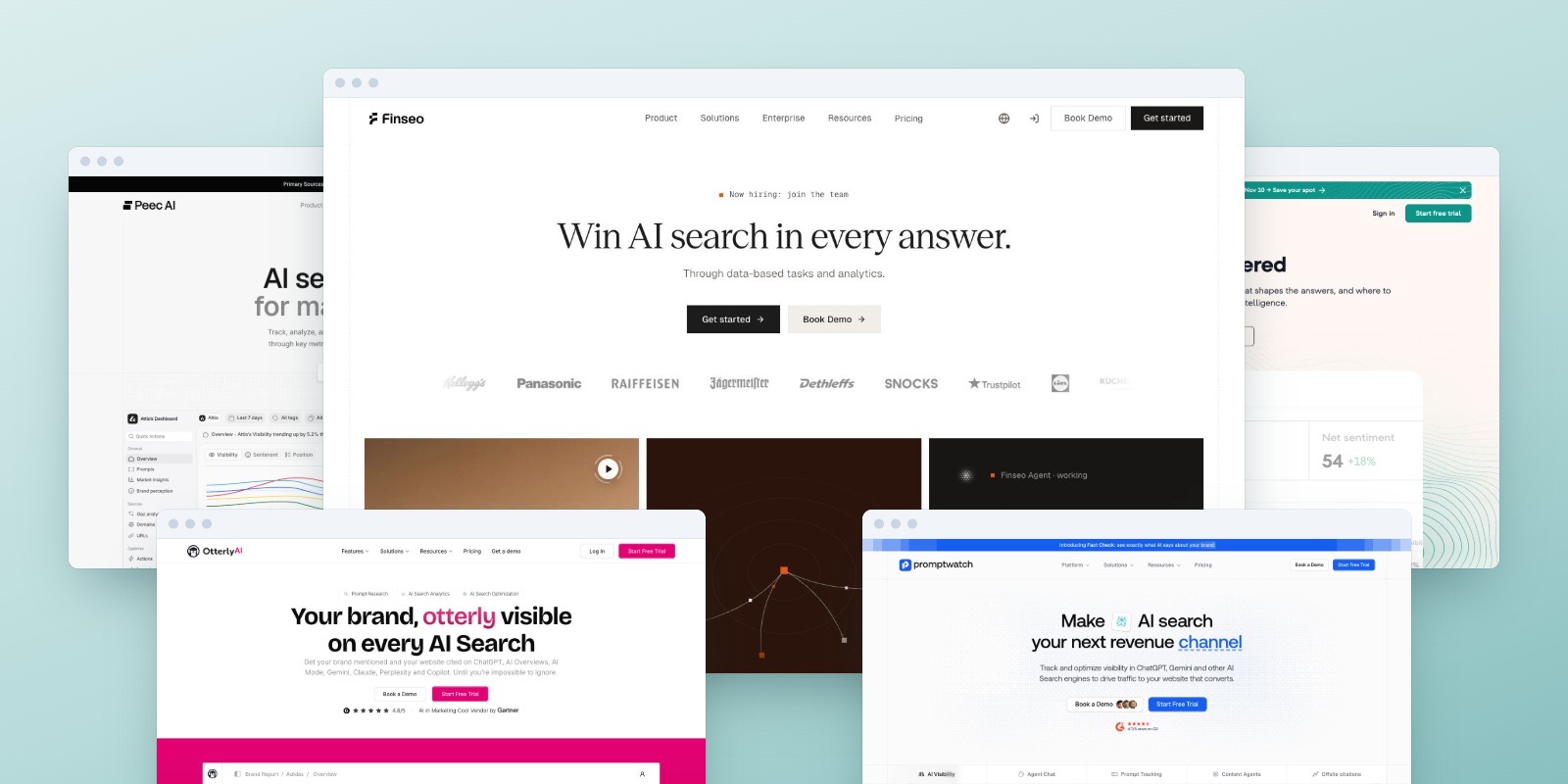
Finseo’s documentation defines visibility as answers containing a brand mention or the brand’s domain citation. Its citation tracking reports cited domains, source types, citation counts, and the answers associated with sources.[5] For enterprise teams, Finseo offers SSO via SAML, roles per project, an audit trail and unlimited seats, and it is hosted in Frankfurt, Germany, with EU data residency. According to its enterprise page, Finseo is GDPR-compliant, provides a data processing agreement (DPA) and is ISO 27001 certified.
These definitions answer different questions:
- Mention: Was the brand named?
- Visible citation: Was the domain or page shown as a source?
- Retrieved source: Did the system use or access the page, whether or not it displayed it?
- Citation position: How prominently did the source appear?
- Referral: Did the answer generate a visit or conversion?
A comparison should identify the event being measured before comparing platform scores.[12][11]
What does the research imply for content and SEO teams?
First, ranking highly in classic Google results is useful but not sufficient. Published overlap studies find that many AI Mode citations come from pages or domains outside the organic top 10, although the size of that difference depends on the study design.[6][19]
Second, community, video, reference, specialist, and Google-hosted sources deserve monitoring alongside conventional editorial competitors. Recent leaderboards repeatedly place Reddit, YouTube, Wikipedia, Google, Facebook, and other platforms near the top, but their rankings change by panel and date.[3]
Third, citation monitoring should be prompt-specific. A broad public leaderboard cannot tell a brand whether its own product pages, comparisons, support content, profiles, or third-party mentions appear for the queries that matter commercially.
Finally, AI Mode and AI Overviews should be tracked as separate surfaces. Ahrefs found only 13.7% citation overlap between them in a 540,000-pair study, while Google states that the two surfaces may use different models and techniques.[12]
Frequently asked questions
Which websites does Google AI Mode cite most often?
Recent studies repeatedly identify Google properties, Reddit, YouTube, Facebook, Wikipedia, Instagram, and other community or specialist sites as prominent sources.[3][15] The leader changes by study: Ahrefs’ November 2026 US snapshot puts Google first, while Surfer’s October 2026 tracked-prompt panel puts YouTube first.[2][7]
Does Google AI Mode mainly cite pages that rank in the organic top 10?
No single overlap figure answers that question. Moz reports 12% strict URL overlap, SE Ranking reports 14% URL similarity under a Jaccard method, and seoClarity reports that 28% of sampled queries shared at least one top-10 URL.[6] These are different measurements, so they should not be treated as contradictory or averaged.
How many citations does a Google AI Mode answer contain?
Published studies report different counts because they count different link types and periods. SE Ranking reported a mean of 12.6 URLs per response in June 2025, Semrush reported an average of seven unique sidebar domains for queries with a sidebar, and Moz reported that 91% of answers cited at least 10 sources.[6][14] Evertune later documented major changes in direct citation URLs and Google redirects during August and September 2026.[16][2]
Does Google AI Mode cite Reddit and YouTube?
Yes, Reddit and YouTube appear prominently in multiple published datasets. Ahrefs ranked Reddit second and YouTube third in its November 2026 table, while Surfer ranked YouTube first and Reddit second in its October panel.[7] Their prominence does not establish that either site will lead for a particular industry or prompt set.
Are AI Mode citations the same as AI Overview citations?
No. Google says AI Mode and AI Overviews may use different models and techniques, and Ahrefs found 13.7% citation overlap between the two surfaces in a 540,000-query-pair study.[12] A domain that appears frequently in AI Overviews may therefore perform differently in AI Mode.
What should a brand track to measure AI Mode citations?
Track the exact prompt, date, market, surface, visible answer, displayed and resolved URLs, source type, citation position, cited page, cited domain, brand mention, and referral outcome. Keep own-domain citations separate from Google-hosted destinations and distinguish visible citations from retrieved-but-uncited sources when the tool reports them.[5]
Sources
- 1Characterizing Web Search in the Age of Generative AI — aclanthology.org
- 2AI Search Statistics & Trends 2026 - iPullRank — ipullrank.com
- 3The Most Cited Domains by LLMs | Similarweb — similarweb.com
- 4The 50 Most-Cited Websites in Google AI Mode (November 2026) — ahrefs.com
- 5How to track your AI citations and sources with Semrush — semrush.com
- 6AI Mode Research: Sources, Volatility, & Differences between AIO and Organic Search — seranking.com
- 7The 50 Most-Cited Domains in Google AI Mode (October 2026) — surfer.ai
- 8What Gets Cited by Google AI Mode? · Search Institute — searchinstitute.co
- 9Is AI Mode Now Dominated by Google’s Self-Referencing Links? — seranking.com
- 10Google AI Mode Cites Itself 4.5x More Than AI Overviews. Your Brand Can Still Be Winning. | BrightEdge — brightedge.com
- 11The content types most cited by LLMs — wix.com
- 12Are AI Mode and AI Overviews Just Different Versions of the Same Answer? (730K Responses Studied) — ahrefs.com
- 13Citation Worthiness: Which GEO Tactics Hold Up Across 96,418 URLs - SISTRIX — sistrix.com
- 14Google AI Mode vs. Traditional Search & Other LLMs [Study] — semrush.com
- 15Only 12% of AI Mode Citations Match URLs in the Organic SERP - Moz — moz.com
- 16AI Mode Citations Fell 82% in Three Weeks — evertune.ai
- 17Expanding AI Overviews and introducing AI Mode — blog.google
- 18AI Features and Your Website | Google Search Central | Documentation | Google for Developers — developers.google.com
- 19Do Better Google Rankings Translate to AI Mode Visibility? — seoclarity.net
- 20Synthetic Sources?: Auditing Generative Search Engine Citations for Evidence of AI-Generated Sources | Proceedings of the AAAI/ACM Conference on AI, Ethics, and Society — ojs.aaai.org
- 21Understanding sources — docs.peec.ai
- 22Tools Reference — docs.peec.ai
- 23Ahrefs Brand Radar: Study your brand’s AI visibility — ahrefs.com
- 24AI Visibility Metrics — semrush.com
- 25Understanding your metrics - Peec.ai Docs — docs.peec.ai